Slow Fade

(picture Ai generated)
Nobody tells you that most endings don’t end. They fade.
And no, we’re not talking about Slow Fade, the SoundCloud rapper currently trying to convince America that mumbling into a laptop microphone is an art form. We’re talking about the actual slow fade, the one that quietly removes people, places, routines, and entire versions of yourself while you’re busy doing something else.
We are culturally conditioned to expect our life transitions to arrive with the cinematic gravity of a movie trailer. We want slammed doors, tear-streaked monologues, and dramatic soundtrack music swelling as we walk away from the burning building of our past. We want a funeral for our habits and a press release for our friendships. Real life, unfortunately, doesn’t work that way.
Most of the time, the things that shape your existence simply evaporate while you’re busy looking at your phone. It’s the friend you used to text every day whose life once mirrored your own. Now they’re someone you think about every few months while standing in line for coffee, wondering if they’re still obsessed with that band they spent three years trying to convince you would change your life. It’s the restaurant you visited with religious devotion, the place that witnessed bad dates, good conversations, and at least three emotional breakdowns disguised as lunch. Now it’s been replaced by a generic place closer to home because, let’s be honest, you’re too old to drive twenty minutes for a sandwich.
It’s the city that once felt like possibility itself.
For me, that city was Minneapolis-St. Paul.
I knew where everything was. I knew which Cub Foods carried the good potato salad. I knew which coffee shops had outlets that actually worked. I knew which roads to avoid after a snowstorm and which friends would answer the phone if I called at 9:00 p.m. Now I live in Nashville, and some days Google Maps still acts like we’re being formally introduced.
The strange thing is that Minneapolis-St. Paul didn’t disappear. The lakes are still there. The neighborhoods are still there. Somewhere, people are still standing in line at the coffee shop where I used to know exactly what I was ordering before I walked through the door. The winters are still trying to kill us.

But the version of me that lived there isn’t.
Now, to be fair, my departure from Minneapolis-St. Paul was anything but subtle.
I didn’t leave because I got bored and wanted a change of scenery. I left because a thirty-year marriage ended. I sold my house, packed up my life, and moved nine hundred miles away to a city where I knew almost nobody.
There was nothing slow about that part.
The move was an earthquake.
The Slow Fade came afterward.
It showed up in the months that followed when I realized I no longer knew what was happening back home. Local news stopped feeling local. People stopped calling with updates because I wasn’t there anymore. Places I had known for years became places I used to know. A city that had been my present slowly became part of my past.
That’s the thing about a slow fade. You don’t realize it’s happening while it’s happening.
I spent years being a wife. I spent years knowing exactly who I was and where I belonged. I spent years building a life that felt permanent because that’s what we tell ourselves permanent things are supposed to feel like.
Then one day I found myself living nine hundred miles away, in a city I never planned to call home, writing articles on the internet and attending comedy shows by myself.
There wasn’t a single moment when that happened. No giant flashing sign. No dramatic announcement. Just thousands of tiny moments quietly rearranging my life while I wasn’t paying attention.
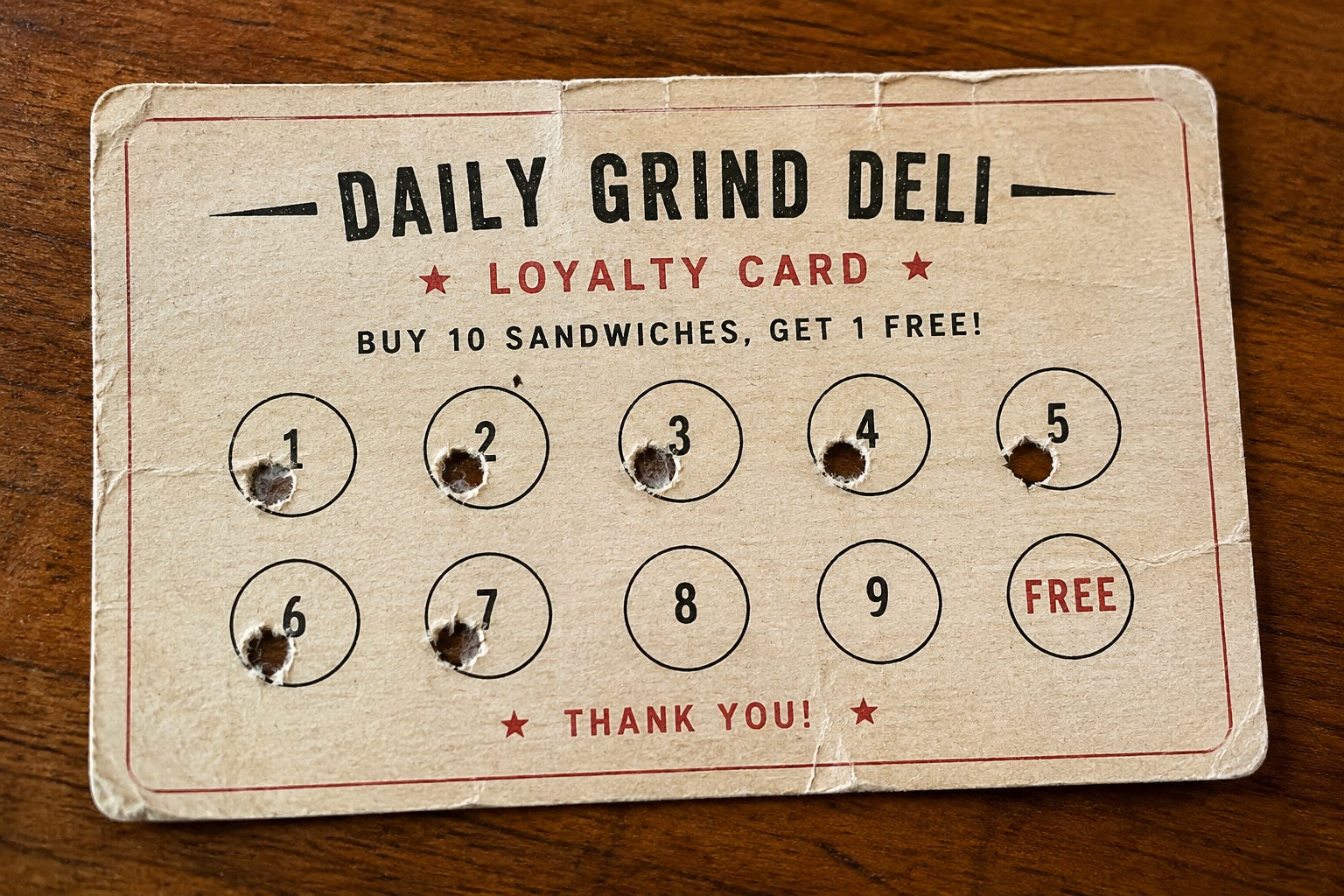
I found an old loyalty card in my wallet the other day. It was for a deli I haven’t visited since 2021. Apparently, I was only three sandwiches away from a free one.
That’s a tragedy if you think about it.
Somewhere out there is a deli owner wondering why I abandoned a relationship that was clearly getting serious. We were on the verge of something meaningful. I was three meals from greatness. And then I just disappeared.
The truth is I didn’t consciously decide to stop going there. I simply woke up one day and realized I had become a different person. The deli regular was gone. In her place stood someone with a meal-delivery subscription, lower expectations, and slightly higher cholesterol.
Nobody talks about this kind of heartbreak. Not because it’s devastating, but because it’s ordinary.
We think our lives change because of the big events. The divorce. The move. The layoff. The funeral. We treat those moments like the tectonic plates of our biography, the major turning points that explain everything that came before and everything that followed.
But the truth is those events are often just the headlines. The real story unfolds afterward, quietly and without much fanfare. The change happens when nobody is paying attention. It’s the day you stop reaching for an old routine, the day you realize you no longer know the weather back home, or the day a friend crosses your mind and you realize you haven’t spoken in a year. Not because of a fight. Not because of some dramatic betrayal. Just because life kept moving, and so did you.
It’s tempting to turn all of this into a complaint list. To sit in the quiet of a Tuesday night and mourn the steady, invisible loss of a former life. I’ve certainly done it.
But the longer I live, the more I think the Slow Fade isn’t a glitch in the system. It’s the system itself. It’s the natural consequence of continuing to exist. We like to believe we’re carefully curating our lives, deciding which relationships, routines, and identities get to stay. We’re not. Life edits us whether we participate or not. The old chapters fade so the new ones can become readable.
One day you simply realize that the life you spent years building has become a story you tell instead of a place you live.
And while you’re busy mourning what disappeared, something else is already taking its place.
While you’re mourning the version of yourself who stayed out until 3:00 a.m., you’re missing the version who sleeps through the night and knows where the ibuprofen is. While you’re mourning the friendship that drifted away, you’re overlooking the people quietly drifting into your orbit. They don’t know who you used to be. They’re not comparing you to a previous version of yourself. They simply meet you where you are, and that may be one of the greatest gifts adulthood offers.
Nobody notices the Slow Fade while it’s happening. And somehow, while you were busy mourning what disappeared, a new life moved in and started paying the utilities.
So let the old versions fade. Let the punch cards go unused. Let the restaurant become someone else’s favorite place.
You aren’t disappearing. You aren’t being erased. You’re being rewritten.
And rewriting is almost never dramatic. It happens in the silence between texts, in the gap between the loyalty card and the trash can, and in the quiet, unannounced moment when you realize you’ve become someone entirely new.
Because while some people, places, and versions of ourselves are fading out, something else is always fading in.
And if you’re lucky, a few years from now you’ll look back and realize that the version of yourself reading this article faded away too. Not because they failed. Not because they were lost. Because they made room for the person who came next.
Or maybe you’ll just find a better deli.
That’s the thing about life. We spend years searching for meaning, closure, and personal growth.
Sometimes the answer is a sandwich.
Des.
I have tears.
This…
“You aren’t disappearing. You aren’t being erased. You’re being rewritten.”
Thank you for your words.
They landed DEEPLY.
I love this so much. I’ve changed a lot over the last year or so and I am very much in an in-between stage of who I was and whoever the heck I’m going to be. But this made me think that maybe it’s not actually that dramatic at all. Maybe this in between is just life. I don’t think we actually ever leave this place and reach that solidly next stage. We just slowly transition into and out of stage after stage.